Showing posts with label art feature. Show all posts

2013/06/27

Not So Monthly Art Feature : Conversation with North Carolina's Bob Trotman

John - Bob Trotman; 2006; Wood, tempera, wax, steel; Photos courtesy of the artist
John, 2006

Winston-Salem native Bob Trotman is a self-taught sculptor working out of rural Casar, NC. Three of his charged busts were on display in 2011 at Blue Spiral 1's WOOD Moving Forward exhibition in Asheville, NC. Our conversation follows.


No Brainer - Bob Trotman; 2010; Wood, paint, wax; Private collection; Photo courtesy of the artist
No Brainer, 2010

JRun: Many sculptors seek emotional expression in clay, steel, bronze, or stone. How did you discover wood as an emotional medium?

Bob Trotman: I make everything in fired clay (terra cotta) before carving it in wood. The clay is where much of the creativity happens. I formulate my ideas in clay first and then cut and assemble the wood to realize the model.
Studio Shot: work table with terra cotta maquettes - Bob Trotman, 2012, Photo courtesy of the artist
Studio Shot: work table with terra cotta maquettes, 2012
The wood never dictates the form or idea for me, but I value the moral (and mortal) quality it imparts to my figures. Wood was the first material I tried, originally in 8th grade shop class, later as a back to-the-earth hippie in the early 70's. It is readily available, pleasant to work with, durable, and beautiful to behold. It also has a populist vernacular quality that I like. I am following in the tradition of religious carvings, ship's figureheads, and tobacconists' Indians, but with a dark twist for my chronicles of corporate purgatory. Still it's Americana in a way, the story, not of our heyday, but rather our decline. Wood has an honest, human quality that I favor. It is the flesh of trees.

JR: Americana is certainly an appropriate association. Would you also describe your work as contemporary folk art?

BT: Folk art is usually attributed to the naive, and while I am self-taught, I am not naive. My work does have the populist tradition in common with folk art, though.
Cake Lady - Bob Trotman; 2002; Wood, tempera; private collection; Photo courtesy of the North Carolina Museum of Art
Cake Lady, 2002
 JR: While we are breaking down labels, your work is sometimes connected with Absurdism and also Figurative Expressionism . . . 

BT: I have said it represented an absurdist narrative of corporate purgatory, absurdist not because of an art movement, but because you would never see the sorts of things I am showing. I don't think that the greedy and powerful really suffer very often as a result of their misdeeds. So I try to take care of that in my imaginary world. It's not Expressionism. That involved much more distortion and crudity of fracture.
Deskman - Bob Trotman; 2011; Wood, tempera, latex, wax, steel, concrete, casters, electricals, artificial plant; Photo courtesy of the artist
Deskman, 2011
 JR: I would agree that your use of fracture is not at all crude. Can you speak of the importance of checking in your work?

BT: I like the cracks (Wabi-sabi = the Japanese appreciation of the beauty of imperfection). I try to position the cracks so that they add to the emotion expressed in the piece.
Stu - Bob Trotman; 2004; wood, tempera, wax, steel; Photos courtesy of the North Carolina Museum of Art
Martin - Bob Trotman; 2008; Wood, tempera, wax; Photo courtesy of the North Carolina Museum of Art
Stu, 2008; Martin, 2008
JR: You seem to have a very deep connection to wood. Is there a special place from which you source your materials?

BT: I use basswood and poplar. In the larger figures I use poplar (from logs) for the bodies and basswood for the heads, hands and feet. The smaller figures are all basswood. The poplar comes from logs I buy at local sawmills or cut myself. It cracks as it dries. The basswood, which grows in northern climes, comes on a big truck from a dealer in Charlotte. It is kiln-dried and must be ordered in lots of 1000 board-feet or more.

JR: When I look at your story, and your work, it is an inspiration and a reminder: that dedication and skill will stil pay off, even for an artist. There are labels thrown onto unsuccessful artists, especially in youth - immature, layabout, druggie, misfit, etc. And then there is the reality of the starving artist . . .

BT: ". . .dedication and skill will still pay off, even for an artist." I'd say, "especially for an artist." A good motto for the artist is: "They can't stop me from being an artist!" It is wise to be aware of the cliches about artists, which you mention, and do one's best not to accept them uncritically because they become self-fulfilling and self-defeating. There may be a niche that society  puts you in, but you don't have to accept that. Part of being an artist is to create an independent sense of your own worth and not to passively accept what society may lay on you. You have to be proactive rather than reactive.

How do you measure success? Who decides that? You or them? Here again, you have to take charge. Nobody is going to do this for you. If you measure success as making a lot of money, you will perceive yourself one way. If you measure it as being able to live an interesting life doing work you like, you will see yourself in a different way. It may not be the way society sees you, but it is up to you to create the story that plays in your head. It's part of being an artist.

You start with the work you want to make. You make it for yourself. Everything else is secondary. How do you support that work? Day job? Teaching? Some combination? You have to figure it out strategically. "Work smarter, not harder."

JR: Did you struggle through poverty to get where you are today? Or did you fall back on a good day job to pay the bills and then burn the midnight oil on your art?

BT: From the very beginning I decided to keep my overhead as low as possible: to live where it was very cheap and sell where it was expensive. So my wife Jane and I fixed up an old farmhouse (no mortgage) out in the country, 25 miles from any town, and traveled to New York and other big cities for marketing purposes. At first we drew our water from a well with a bucket. Wood heat. Hand tools in the studio. That was the mid-70s, but we were hippies and it was fun, not a hardship. Not having grown up poor, 'poverty' was a novelty for me. I had been a teacher for a few years before that and had never really done physical labor. I found it liberating.


JR: Can you share any fresh work that shows your newest direction/excursion?

BT: Shaker, 2012, maquette, terra cotta. 7" long.
Shaker (maquette) - Bob Trotman; 2012; terra cotta; Photo courtesy of the artist
This may be scaled up and carved in wood eventually.

I am also beginning to make kinetic work. You might want to include this video of Minder:


JR: Where can we see your art in the future?

BT: My next big show will be at the Visual Arts Center of Richmond in 2014.

Thanks,
Bob

[Bonus Material: Inverted Utopias at the NC Museum of Art, 2010-2011]

2012/05/18

What's Up?

North Carolina's Bob Trotman  is June's featured artist. Post questions for him in the comments of this post.
Bob Trotman, No Brainer, 2010; wood, paint, wax; private collection

I have done a lot of repair and some festival-going in the last week and a half. A few beautiful mashup things were sold quickly and I don't have pictures. One was an 80's shaped hardwood desk base that I matched up with a vintage sheet of bird's eye maple veneer plywood for the top. The bottom layer of the bird's eye looked like weathered leather but it may have been a severely distressed finish applied very thick? About 40x22, 7-layer finish ply with a drawer pull (type of thing) cut out along one edge - the most unique piece of scrap I've run into in a long time!

On this Formica table, I painted the legs burgundy.
The legs on this vintage 2-level corner coffee table have since been painter burgundy.

Then I built Icehouse II bookcase on commission:
Custom designed Icehouse II bookcase is assembled from reclaimed, repurposed wood sourced locally in Asheville, NC
 Starting with the door (backing), I cut of the bottom to make it even and to clean off a thin layer of woodrot in the endgrain. The worn, graffitied door was beaten apart from the sides of the tool cabinet it once enclosed, so splintered edges were split off with a chisel. I then wire brushed away the loose paint chips and triple-coated it with water-based polyurethane front and back.(4 layers on exposed endgrain) The hinges were busted off to remove this one, but the bent latch is intact and rotates freely. (Icehouse I Bookcase also had hinges)
The detail of Icehouse Bookcase II shows the irregular bead-board backing and moving latch plate.
The side panels are cut from the plywood back of a very strange old stereo cabinet. I may cannibalize the rest and will try to remember to take pictures of it first. I gave bits of the componentry to Susan for the future making of a Bot.

The shelves are the very last of the shelf-stock donated by our neighbor Sam from a library tear-out in the early 90s. (Previously, I guessed they had come from a prior incarnation at 201 Haywood Rd.) I lost the shop countersink for about a week, so I used a flat auger bit in its absence. With a wide pilot, the flat recess created by the auger seems to create a lock-tight effect when the wood screws bite in at the end. So, lesson learned: losing tools leads to innovation. Lose your tools often as long as you are certain to find them again later.
I do not endorse Ali Baba's flat auger bit set.

___
] j [


2012/05/03

JRun presents : monthly art feature : Interview with Ron van der Ende


Ron van der Ende Still Life 2010 bas-relief in salvaged wood 180 x 102 x 12cm (private collection NY NY)
Still Life, 2010 (studio)

I discovered Dutch woodworking artist Ron van der Ende on Empty Kingdom. Soon after, I contacted him about featuring his work on CARPEntryDIEM. He was remarkably open about his passion and process. Following is a portion of our conversations.

Ron van der Ende Flawless 2007 bas-relief in reclaimed timbers 95 x 75 x 10cm (private collection den Haag, NL)
Flawless, 2007
JRun: When did scrap material begin to fuel the majority of your work?

Ron van der Ende: I started restricting myself to old wood as material for my sculptures in 1996 because it boasts a wealth of color and texture, it is readily available and inexpensive, and because it is inherently 'imperfect'. Sometimes it looks like it has been touched a million times. It feels good to make something of value from such a modest material.
Ron van der Ende Axonometric Array 2008 bas-relief in reclaimed timbers, size variable ca. 7m50 x 3m50 x 25cm Built on assignment for WORM alternative music and film venue in Rotterdam (on permanent display)
Axonometric Array, 2008 (studio)
JR: "...touched a million times." I love that idea; some of your work really wants to be touched. So, how did found wood bring you to bas-relief?

RvdE: I vividly remember having my 'eureka!' moment. It suddenly dropped into my head that I could work in this material almost flat to produce a large and light sculpture. I realized instantaneously that it could be done, that it would be possible to do cars and limitless other subjects. That I would not need any detailed technical drawings but just one photograph. And that the result would be unique and spectacular and sell like hot cakes.
Ron van der Ende Fly Over 2002 bas-relief in old wood. 350x210x20cm. Built on assignment for Hogeschool Rotterdam (Rotterdam University)
Fly Over, 2002 (studio)
JR: An influence from photography is not at all surprising, but it never occurred to me. The work plays with flatness and dimensionality, so maybe photography is just hiding in plain sight.

RvdE: It felt then (and it feels now) like I have stumbled upon a continent of possibilities that is mine alone to explore. And twelve years on, there is still so much opportunity to develop and grow.
Ron van der Ende Vostok 2006 bas-relief in reclaimed timber, 130 x 130 x 14cm (private collection)
Vostok, 2006
It allows me to use both painterly and sculptural solutions. Because of the 'illusion' it tends to draw people in, also people without any existing fondness for art. Also I always liked the idea of a fixed vantage point for anybody looking at a sculpture because it is a big nono with the crafts teachers. In fact it is the same with the use of colors. I'm a bit of a rebel in my own modest way!
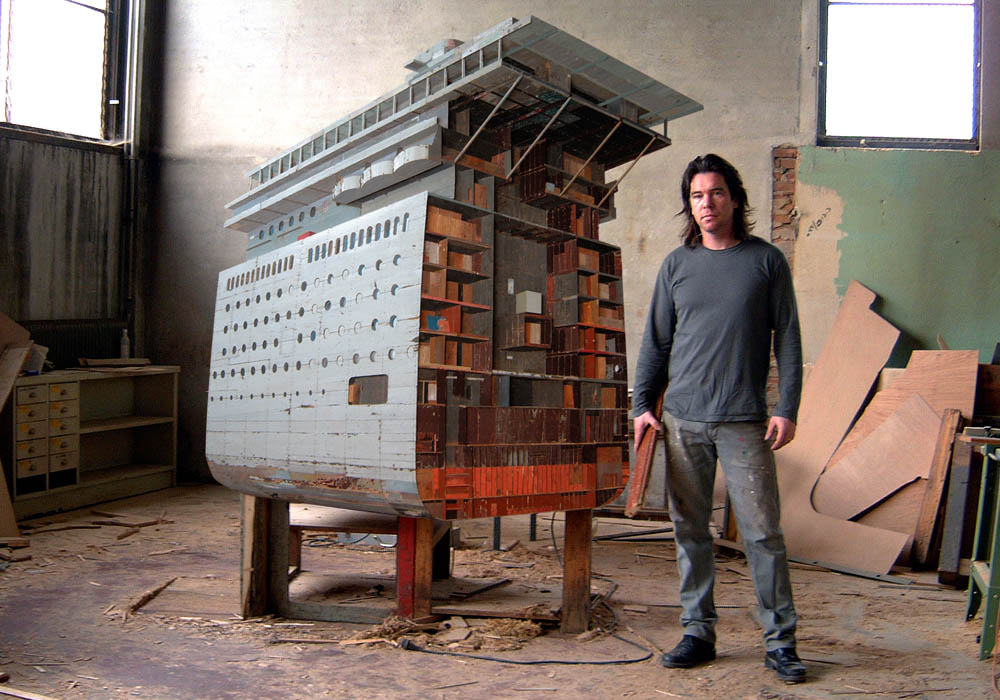
Ron van der Ende Shipsection 2003 bas-relief in used wood, 185x195x16cm, (corporate collection Rotterdam)
Ron van der Ende Bathyscaphe Trieste 2010 bas-relief in salvaged wood 110 x 84 x 12 cm (private collection Rotterdam, NL)
Shipsection, 2003 (artist in studio) & Bathyscaphe Trieste, 2010
JR: Where do you collect most of your scraps?

RvdE: Most of my material I find in the streets. I find it myself or my friends call to report a dumpster/skip with interesting materials.

JR: Have your material sources changed over the years?

RvdE: It has shifted a little bit to buying materials at specialized stores because not as many material is being thrown away as a couple of years ago. People are making their own fake Piet Hein Eek furniture with it. Sometimes I buy stuff from the internet, like in 2008 I bought a lot of two hundred and fifty antique doors. That makes a full truckload!

JR: Have you developed relationships by collecting scraps from practical woodworkers or other artists?

RvdE: Not really. The scraps have to be old you know. 

JR: I know some old woodworkers here in Asheville. Maybe I will send you a few of their scraps.

RvdE: YEAH!
Ron van der Ende Plymouth Custom Suburban 1969 2000 bas-relief in used wood, 205x95x16cm (corporate collection Barendrecht, NL)
Ron van der Ende G.A.Z.21 Volga 1962 2000 bas-relief in old wood, 190x110x16cm (private collection Rotterdam)
Ron van der Ende Capri 2002 bas-relief in used wood, 180x125x16cm (private collection Rotterdam)
Plymouth Custom Suburban 1969, 2000; G.A.Z.21 Volga 1962, 2000; Capri, 2002
JR: Some commentaries have attributed a dark industrialism to your work. Is this an atmosphere that you intend to project?

RvdE: Mostly I'm dealing with sculptural qualities. I do not want aesthetics or style to be dominant in my work. And there is a conceptual side but not as 'words intended to justify the work', more as a strategy for possible associations. This becomes especially interesting when pieces are made in a deliberate combination. I used to work in themed series in the past. Series of cars for example, a set about polar exploration or space flight. But in recent years I've started trying on seemingly illogical combinations to great effect. In the end though, every single piece will have to be strong enough to survive in the world individually.
Ron van der Ende DS II (Pallas) 2008 bas-relief in reclaimed timbers, 100 x 61 x 10cm
Ron van der Ende Phoenix: Rise ! (Pontiac Firebird Trans-Am) 2011 bas-relief in salvaged wood 260cm x 95cm x 18cm
DS II (Pallas), 2008 & Phoenix: Rise ! (Pontiac Firebird Trans-Am), 2011 (studio)

Ron van der Ende Still Life 2010 bas-relief in salvaged wood 180 x 102 x 12cm (private collection NY NY)
Ron van der Ende On Re-Entry (Burning Log) 2010 bas-relief in salvaged wood 262 x 87 x 12 cm (private collection, Seattle, WA)
Still Life & On Re-entry (Burning Log), 2010
 JR: Maybe it's too obvious, but did you play around with On Re-Entry (Burning Log) and Still Life? You know, having them speak to one another at an exhibition?

RvdE: I have not had these pieces together in a show, unfortunately. Mostly my work sells on the first exhibition they are shown in, so not much opportunity to make combinations like that. It's a shame in this case. Both these pieces have a life and death angle that would have made for a nice combination.

JR: Do you have any details or construction shots from those two endeavors?
Ron van der Ende On Re-Entry (Burning Log) 2010 bas-relief in salvaged wood 262 x 87 x 12 cm (private collection, Seattle, WA)
On Re-Entry (Burning Log), 2010 (construction, details, studio)
RvdE: I did not have any of the Still Life piece, but some nice shots were made by the "Happy Famous Artists" Collective. You should ask their permission though. Tell then I sent you! They can be reached through their blog.
Ron van der Ende Still Life 2010 bas-relief in salvaged wood 180 x 102 x 12cm (private collection NY NY)
Still Life, 2010 (details via Happy Famous Artists Collective)

JR: You showed "Perishables" at the Armory in NYC in 2011 and, sadly, we missed it. Do you have any upcoming shows in the US?

RvdE: I'll have a solo show in the spring of 2013 with Ambach & Rice Gallery in Los Angeles.
Ron van der Ende 727 2008 bas-relief in reclaimed timbers – 310 x 140 x 16cm (West Collection, PA, USA)
Ron van der Ende KO Valkyrie 2010 bas-relief in salvaged wood 212 x 130 x 15cm (private collection Rotterdam, N.L.)
727, 2008 & KO Valkyrie, 2010

JR: I would also like to include this video if you are happy with it:


RvdE: Sure. It's in Dutch though... I would translate but I'm terribly busy right now. At one point I tell the cameraman that I am sawing "a very tricky little piece of wood."

JR: Thank you very much for speaking with me and my community. It was a pleasure to get to know your work.

RvdE: Of course. Let me know if you have any more questions.

Best,
Ron van der Ende
Ron van der Ende Checkout2 / Kassa2 2005 bas-relief in reclaimed timber, 187 x 112 x 14cm (private collection Amsterdam NL)
Checkout 2 / Kassa 2, 2005

(June's featured artist is North Carolina's own Bob Trotman. If you have questions for Bob, please leave them here,
in the comments)