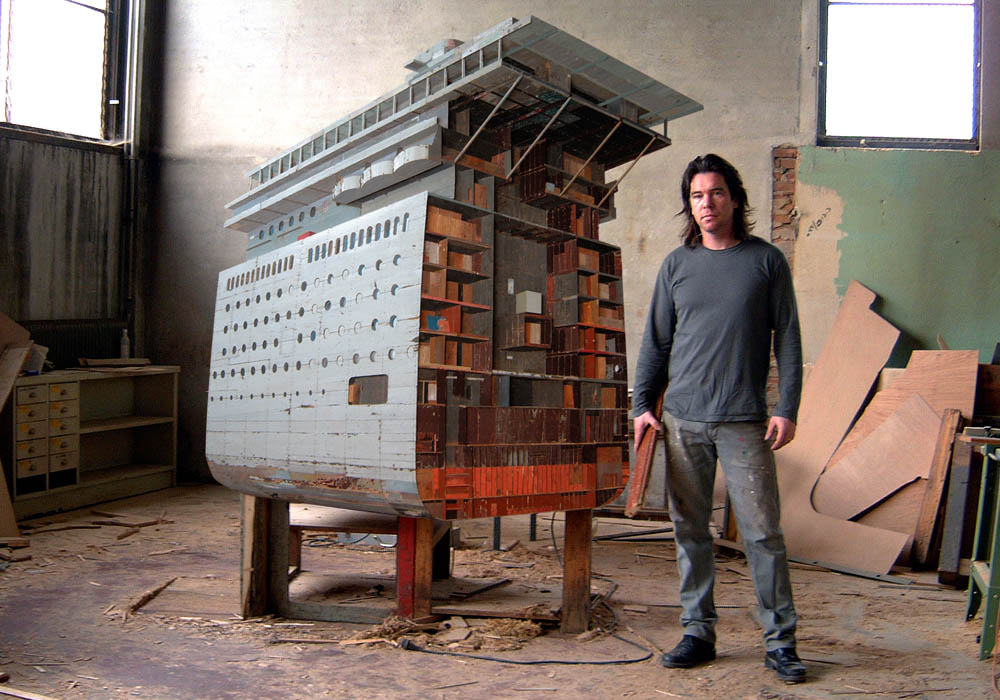
|
| Still Life, 2010 (studio) |
I discovered Dutch woodworking artist Ron van der Ende on Empty Kingdom. Soon after, I contacted him about featuring his work on CARPEntryDIEM. He was remarkably open about his passion and process. Following is a portion of our conversations.
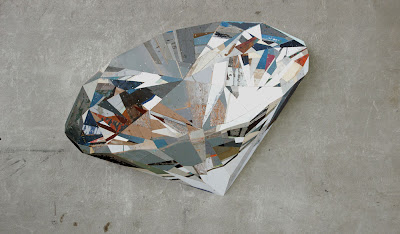 |
| Flawless, 2007 |
JRun: When did scrap material begin to fuel the majority of your work?
Ron van der Ende: I started restricting myself to old wood as material for my
sculptures in 1996 because it boasts a wealth of color and texture, it
is readily available and inexpensive, and because it is inherently
'imperfect'. Sometimes it looks like it has been touched a million
times. It feels good to make something of value from such a modest
material.
 |
| Axonometric Array, 2008 (studio) |
JR: "...touched a million times." I love that idea; some of your work really wants to be touched. So, how did found wood bring you to bas-relief?
RvdE: I vividly remember having my 'eureka!' moment. It suddenly dropped into
my head that I could work in this material almost flat to produce a
large and light sculpture. I realized instantaneously that it could be
done, that it would be possible to do cars and limitless other subjects.
That I would not need any detailed technical drawings but just one
photograph. And that the result would be unique and spectacular and sell
like hot cakes.
 |
| Fly Over, 2002 (studio) |
JR: An influence from photography is not at all surprising, but it never occurred to me. The work plays with flatness and dimensionality, so maybe photography is just hiding in plain sight.
RvdE: It felt then (and it feels now) like I have stumbled upon a continent of
possibilities that is mine alone to explore. And twelve years on, there
is still so much opportunity to develop and grow.
 |
| Vostok, 2006 |
It allows me to use both painterly and sculptural solutions.
Because of the 'illusion' it tends to draw people in, also people
without any existing fondness for art. Also I always liked the idea of a
fixed vantage point for anybody looking at a sculpture because it is a
big nono with the crafts teachers. In fact it is the same with the use
of colors. I'm a bit of a rebel in my own modest way!
 |
| Shipsection, 2003 (artist in studio) & Bathyscaphe Trieste, 2010 |
JR: Where do you collect most of your scraps?
RvdE: Most of my material I find in the streets. I find it myself or my
friends call to report a dumpster/skip with interesting materials.
JR: Have your material sources changed over the years?
RvdE: It has shifted a little bit to buying materials at specialized stores
because not as many material is being thrown away as a couple of years
ago. People are making their own fake
Piet Hein Eek furniture with it.
Sometimes I buy stuff from the internet, like in 2008 I bought a lot of
two hundred and fifty antique doors. That makes a full truckload!
JR: Have you developed relationships by collecting scraps from practical woodworkers or other artists?
RvdE: Not really. The scraps have to be old you know.
JR: I know some old woodworkers here in Asheville. Maybe I will send you a few of their scraps.
RvdE: YEAH!
 |
| Plymouth Custom Suburban 1969, 2000; G.A.Z.21 Volga 1962, 2000; Capri, 2002 |
JR: Some commentaries have attributed a dark industrialism to your work. Is this an atmosphere that you intend to project?
RvdE: Mostly I'm dealing with sculptural qualities. I do not want aesthetics
or style to be dominant in my work. And there is a conceptual side but
not as 'words intended to justify the work', more as a strategy for
possible associations. This becomes especially interesting when pieces
are made in a deliberate combination. I used to work in themed series in
the past. Series of cars for example, a set about polar exploration or
space flight. But in recent years I've started trying on seemingly
illogical combinations to great effect. In the end though, every single
piece will have to be strong enough to survive in the world
individually.
 |
| DS II (Pallas), 2008 & Phoenix: Rise ! (Pontiac Firebird Trans-Am), 2011 (studio) |
 |
| Still Life & On Re-entry (Burning Log), 2010 |
JR: Maybe it's too obvious, but did you play around with On Re-Entry (Burning Log) and Still Life? You know, having them speak to one another at an exhibition?
RvdE: I have not had these pieces together in a show, unfortunately. Mostly my work sells on the first exhibition they are shown in, so not much opportunity to make combinations like that. It's a shame in this case. Both these pieces have a life and death angle that would have made for a nice combination.
JR: Do you have any details or construction shots from those two endeavors?
 |
| On Re-Entry (Burning Log), 2010 (construction, details, studio) |
RvdE: I did not have any of the Still Life piece, but some nice shots were made by the "Happy Famous Artists" Collective. You should ask their permission though. Tell then I sent you! They can be reached through their
blog.
 |
| Still Life, 2010 (details via Happy Famous Artists Collective) |
JR: You showed "Perishables" at the Armory in NYC in 2011 and, sadly, we missed it. Do you have any upcoming shows in the US?
RvdE: I'll have a solo show in the spring of 2013 with Ambach & Rice Gallery in Los Angeles.
 |
| 727, 2008 & KO Valkyrie, 2010 |
JR: I would also like to include this video if you are happy with it:
RvdE: Sure. It's in Dutch though... I would translate but I'm terribly busy right now. At one point I tell the cameraman that I am sawing "a very tricky little piece of wood."
JR: Thank you very much for speaking with me and my community. It was a pleasure to get to know your work.
RvdE: Of course. Let me know if you have any more questions.
Best,
Ron van der Ende
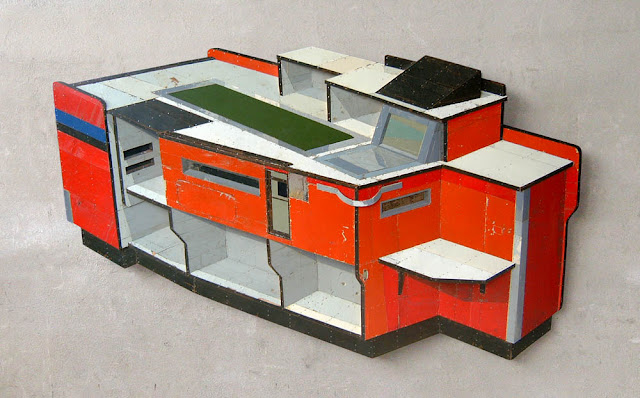 |
Checkout 2 / Kassa 2, 2005
(June's featured artist is North Carolina's own Bob Trotman. If you have questions for Bob, please leave them here,
in the comments)
|